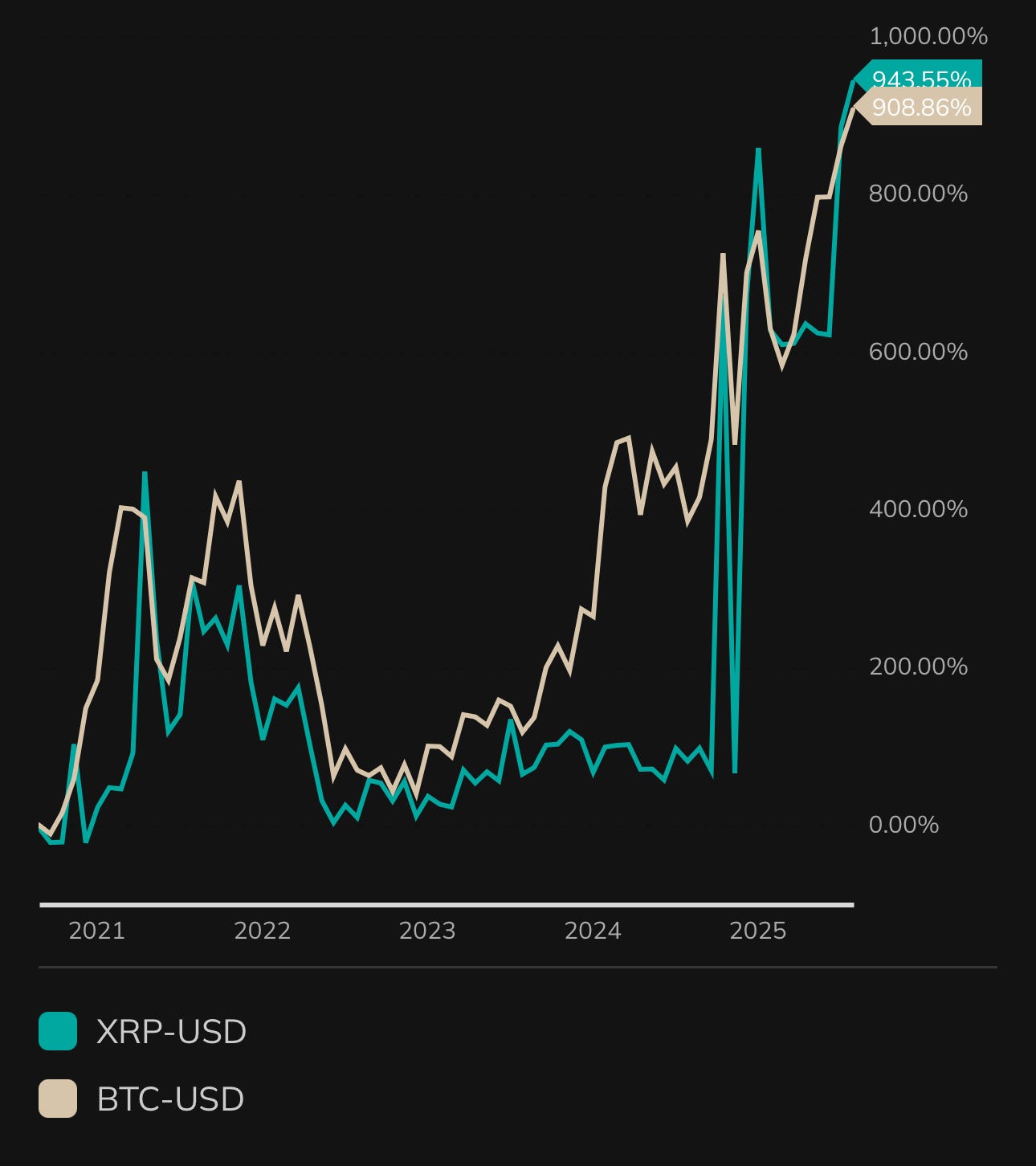
XRP has been making headlines in the cryptocurrency world lately. The price of XRP jumped to $3.35 last week, an 11% jump as institutional buyers pushed the altcoin through resistance and triggered a bullish rally. XRP may be having its moment in the limelight, but I am still uncertain about it. I think it's more likely that XRP is simply another asset acting as a hedge against Bitcoin’s probable bearish cycle. Given Bitcoin’s market dominance, XRP’s recent price action might be more about timing than its actual value.
XRP was created to solve a specific problem. It was designed to make cross-border payments faster and cheaper. On paper, Ripple’s model of using RippleNet and its On-Demand Liquidity service sounds great, as it claims to reduce transaction costs by up to 45% and allows for transactions to be processed in seconds at a fraction of the cost of traditional systems. Despite all of this, will it ever see the widespread institutional adoption Ripple hopes for? Even with its partnerships with names like Santander, PNC Financial Services, and SBI Holdings, it has yet to be widely accepted as the preferred method for cross-border payments. In fact, many of these companies seem more focused on experimenting with Ripple’s solutions rather than fully committing to XRP for the long-haul.
It’s also hard to separate XRP with its years-long legal battle with the SEC, which has accused Ripple of conducting an unregistered securities offering. Even with key victories, the lawsuit was a dark cloud hanging over the altcoin. In a recent surprising turn, the SEC and Ripple agreed to dismiss their appeals, which finally ended the case. Some consider this purely a win for Ripple, but it’s a bit more complicated than that. Ripple had to pay a $125 million fine as part of the resolution, which is less than the original $2 billion the SEC was after, but not nothing. The SEC’s decision to drop the case does provide some clarity, but it doesn’t address the broader regulatory uncertainty that XRP faces.
This brings us to why Bitcoin makes more sense for institutions than Ripple. I have gone down the rabbit hole of XRP, and while it may hold promise for faster cross-border payments, Bitcoin’s role in institutional portfolios is already well-established. Unlike XRP, Bitcoin is a decentralized, proof-of-work-based network that is widely recognized by institutions. Companies like MicroStrategy and Tesla have already made Bitcoin a core part of their balance sheets. Bitcoin’s transparency and decentralized nature give it a clear advantage over XRP.
In the end, XRP’s rise has been driven by several factors, but it still lacks the clear institutional appeal that Bitcoin offers. While XRP’s technology and resilience is good, Bitcoin’s role as a store of value and its decentralized nature make it a far more attractive option for institutions. I do not doubt that XRP will continue to see some success, especially during bullish cycles or periods of volatility. But for me, when it comes to institutional adoption, Bitcoin remains the clear leader.